Beach Shade
The Best Beach Canopies for High Winds
An open canopy is the most wind-exposed shade you can own and, pitched correctly, one of the most reliable. The difference is entirely in the anchor.
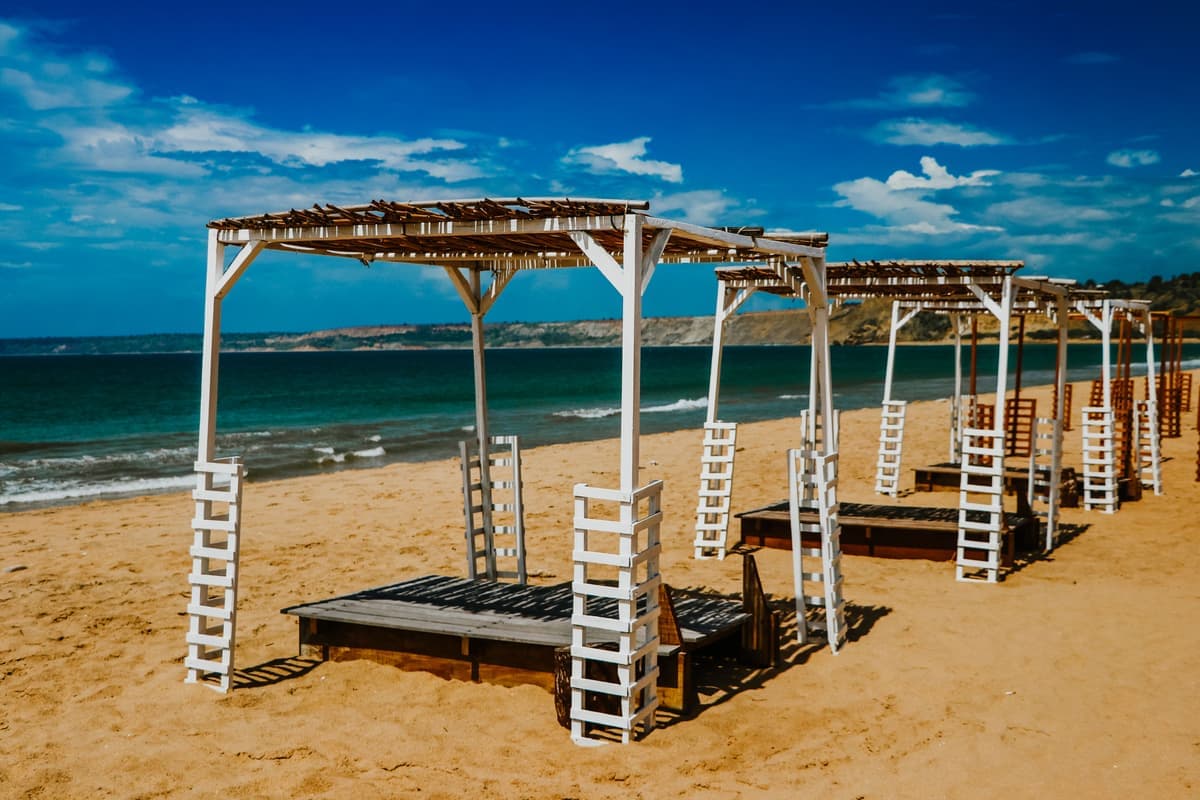 Category photo
Top pick · Beaches with a reliable sea breeze
Shibumi Shade with Wind Assist
A single-arch canopy that the wind holds up rather than threatens, now shipped with sandbag Wind Assist for the days the breeze fails.
Sold direct by the manufacturer. We earn no commission on this link.
Quick picks
| # | Product | Best for | Carry weight | Price |
|---|---|---|---|---|
| 1 | Shibumi Shade with Wind Assist A single-arch canopy that the wind holds up rather than threatens, now shipped with sandbag Wind Assist for the days the breeze fails. | Beaches with a reliable sea breeze | Shibumi does not publish a packed weight on its product page | At Shibumi Shadewe earn nothing |
| 2 | Neso Grande A four-corner stretch canopy anchored with sand-filled bags, sized by Neso for three to six people. | Windy beaches | Neso does not publish a packed weight for the Grande | Check price |
| 3 | 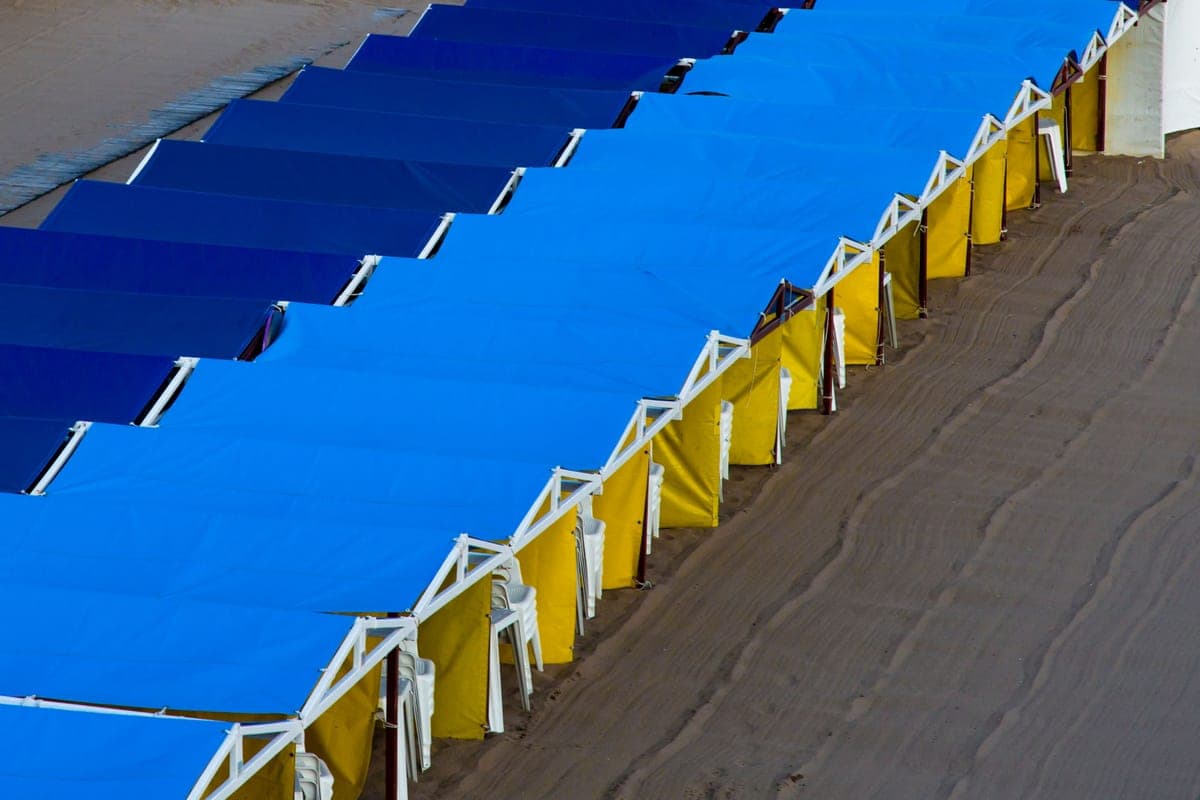 CoolCabana 5, Medium The 43 sq ft CoolCabana: shorter folded than the large, and still well past umbrella coverage. | A cabana that still fits the car | CoolCabana does not publish a carry weight | At CoolCabanawe earn nothing |
| 4 | 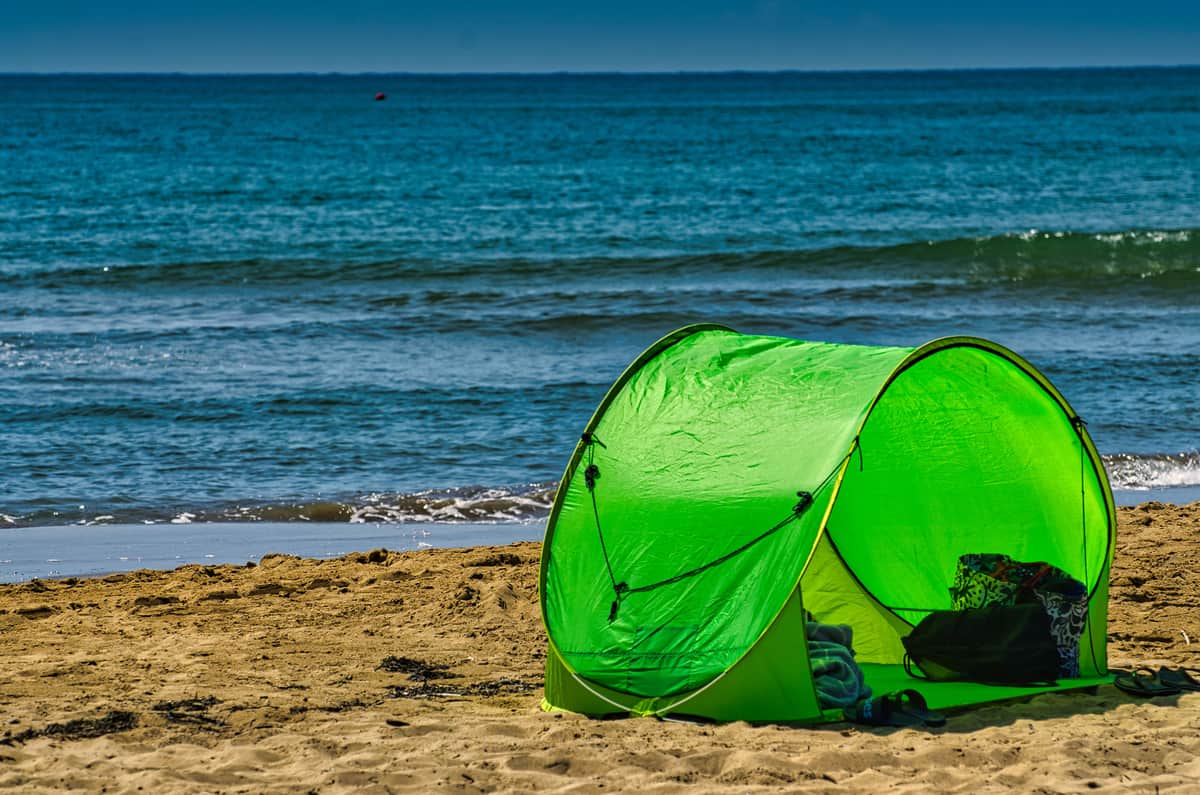 Sun Ninja Beach Tent, 4-Person A pole-and-sand-anchor shade that covers a family without the bulk of a cabana, and the size most people should start with. | Most beach days | 7.9 lb in its bag (Sun Ninja) | Check price |
| 5 | Neso 1 Neso's original and smallest canopy, sized for two to four and anchored with sand rather than stakes. | Two to four people | Neso does not publish a packed weight for the Neso 1 | Check price |
Scroll the table sideways on a narrow screen. Every weight above is the figure its manufacturer publishes; where a manufacturer publishes none, the table says so rather than borrowing a retailer's number.
The short answer
Taut is the whole game
A taut canopy in wind behaves like a membrane: load spreads across the fabric and into the anchors. A slack canopy behaves like a flag, and flapping does two bad things. It fatigues the seams, which is where canopies actually tear, and it shock-loads the anchors with repeated jerks rather than steady pull — and a buried sandbag resists steady pull far better than it resists jerking.
This is why a stretch fabric suits wind. Neso's nylon and Lycra blend has give in it, so a gust stretches the canopy instead of snapping it against its stitching. It also means a Neso pitched loose is worse than a rigid canopy pitched loose, because there is more slack available to flap. Pitch it properly or buy something else.
Size down, and face it correctly
Wind load scales with area and with the square of speed. Both multipliers run against the big canopy. On an exposed beach the 43 sq ft cabana is the sensible buy and the 64 sq ft one is the mistake, and the mid-size Sun Ninja is the sensible buy over the 10 x 10 ft.
Orientation matters nearly as much. Set the lowest edge of the canopy into the wind so air spills over the top rather than catching underneath. A canopy that lifts from below is a canopy that leaves.
What to do when the wind gets up mid-afternoon
- Re-bury the anchors first. Sand dries and loosens through the day, and the anchor you buried in damp sand at ten in the morning is sitting in dry sand by three.
- Re-tension the canopy. Everything stretches and settles.
- Drop one side if the design allows it, turning the canopy into a windbreak rather than a wing.
- If it lifts between gusts, take it down. A shade that has started to move will not stop improving its own escape.
The full procedure, including how to pitch so this is less likely in the first place, is in keeping a beach shade from blowing away.
Every pick in full
Category photo#1 · Beaches with a reliable sea breeze
Shibumi Shade with Wind Assist
A single-arch canopy that the wind holds up rather than threatens, now shipped with sandbag Wind Assist for the days the breeze fails.
| Carry weight | Shibumi does not publish a packed weight on its product page |
|---|---|
| Packed size | Not published; carried over the shoulder |
| Size / capacity | Classic and Mini sizes |
| Setup | One arched pole; the canopy fills with wind rather than being pegged out |
| How it holds down | Wind is the mechanism, not the hazard. Wind Assist sandbags included for still days |
| UPF / materials | Not published as a UPF figure on the product page |
What it does well
- The only mainstream design that gets better as the wind gets stronger
- The current Quiet canopy is Shibumi's answer to the loud flapping of the older fabric
- Wind Assist is now included rather than sold separately, which fixes the design's one real failure mode
Where it falls short
- Sold direct only, so there is no Amazon listing and we earn nothing if you buy one
- Shibumi publishes neither a packed weight nor a UPF number
- On a dead-calm day it needs the Wind Assist to work at all
Sold direct by the manufacturer. We earn no commission on this link.
Specifications above are Shibumi Shade's own, read from their published listing.
Category photo#2 · Windy beaches
Neso Grande
A four-corner stretch canopy anchored with sand-filled bags, sized by Neso for three to six people.
| Carry weight | Neso does not publish a packed weight for the Grande |
|---|---|
| Packed size | Not published; ships in a shoulder carry bag |
| Size / capacity | Sized by Neso for 3-6 people |
| Setup | Fill the four corner anchor bags with sand, raise two poles |
| How it holds down | Corner bags are filled on site, so the hold-down weight is the beach itself |
| UPF / materials | UPF 50+, water-resistant nylon/Lycra blend (Neso) |
What it does well
- The stretch nylon/Lycra canopy gives rather than flaps, which is why this design suits wind
- Anchor weight is sand you fill on arrival — nothing heavy to carry in
- Two poles to deal with, against four on most pole-and-pouch shades
- Neso publishes UPF 50+, and the Skin Cancer Foundation recommends its Sidelines model in the same fabric
Where it falls short
- Neso publishes no packed weight, so you cannot plan a carry-on around it
- A stretched canopy needs its corners pulled genuinely taut or it sags
#ad We do not publish a price we cannot verify today. How this is funded
Specifications above are Neso's own, read from their published listing.
Category photo#3 · A cabana that still fits the car
CoolCabana 5, Medium
The 43 sq ft CoolCabana: shorter folded than the large, and still well past umbrella coverage.
| Carry weight | CoolCabana does not publish a carry weight |
|---|---|
| Packed size | Folds to 3 ft 2 in (CoolCabana) |
| Size / capacity | 43 sq ft of shade |
| Setup | Two middle poles on the medium size, plus a sand spike |
| How it holds down | Sand pockets hold 35 lb of ballast (CoolCabana) |
| UPF / materials | UPF 50+ (CoolCabana) |
What it does well
- Still roughly half again the shade of a 6 ft umbrella, in a shorter fold
- Same 35 lb sand-pocket ballast as the large
Where it falls short
- Uses two middle poles where the large uses one — slightly more to assemble
- No published carry weight
Manufacturer's own store, linked for its spec sheet. We earn no commission on this link.
Specifications above are CoolCabana's own, read from their published listing.
Category photo#4 · Most beach days
Sun Ninja Beach Tent, 4-Person
A pole-and-sand-anchor shade that covers a family without the bulk of a cabana, and the size most people should start with.
| Carry weight | 7.9 lb in its bag (Sun Ninja) |
|---|---|
| Packed size | 17.7 x 7.5 x 7.1 in carry bag (Sun Ninja) |
| Size / capacity | 7.5 x 7 ft canopy, four poles |
| Setup | Bury four sand pouches, raise the poles; pegs included for grass |
| How it holds down | Held by sand-filled pouches you dig in, not pegs pushed into dry sand |
| UPF / materials | UPF 50+ (Sun Ninja) |
What it does well
- The best size-to-weight balance in the range: family coverage under 8 lb
- Sand-pouch anchoring works in dry sand, where tent pegs simply pull out
- Machine washable, which matters more than it sounds after a season of salt
- Ships with a sand shovel and grass pegs, so it works away from the beach
Where it falls short
- Four poles and four buried pouches is a real setup, not a pop-up
- An open canopy: it blocks sun from above but gives no shelter from blowing sand
#ad We do not publish a price we cannot verify today. How this is funded
Specifications above are Sun Ninja's own, read from their published listing.
Category photo#5 · Two to four people
Neso 1
Neso's original and smallest canopy, sized for two to four and anchored with sand rather than stakes.
| Carry weight | Neso does not publish a packed weight for the Neso 1 |
|---|---|
| Packed size | Not published; ships in a shoulder carry bag |
| Size / capacity | Sized by Neso for 2-4 people |
| Setup | Fill the corner anchor bags, raise two poles |
| How it holds down | Sand-filled corner anchor bags |
| UPF / materials | UPF 50+, water-resistant nylon/Lycra blend (Neso) |
What it does well
- The cheapest way into the Neso design
- Smallest canopy of the three, so the easiest to keep taut on a breezy day
Where it falls short
- No published packed weight or packed size
- Two to four people means two adults and two small children, not four adults
#ad We do not publish a price we cannot verify today. How this is funded
Specifications above are Neso's own, read from their published listing.