Beach Shade
Beach Shade for Calm Days
On a windless beach the enemy stops being wind and becomes heat. Canopy area is free, anchoring is almost free, and the one shade that beats everything in a breeze is the one you should leave at home.
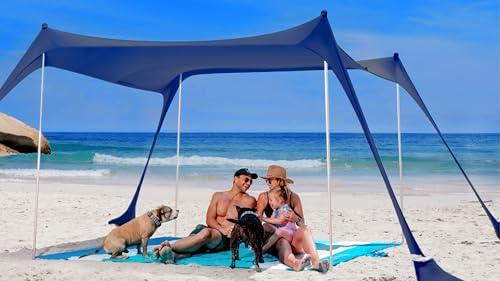
Top pick · Big groups
Sun Ninja Beach Tent, 8-Person
The 10 x 10 ft version of the same design: four times the footprint of the 2-person for less than 3 lb more carry weight.
Quick picks
| # | Product | Best for | Carry weight | Price |
|---|---|---|---|---|
| 1 | Sun Ninja Beach Tent, 8-Person The 10 x 10 ft version of the same design: four times the footprint of the 2-person for less than 3 lb more carry weight. | Big groups | 8.8 lb in its bag (Sun Ninja) | $128.00 · View on Amazon |
| 2 | 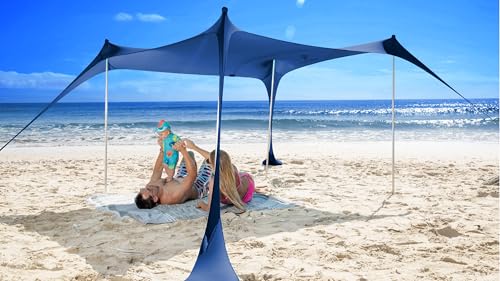 Sun Ninja Beach Tent, 4-Person A pole-and-sand-anchor shade that covers a family without the bulk of a cabana, and the size most people should start with. | Most beach days | 7.9 lb in its bag (Sun Ninja) | $99.90 · View on Amazon |
| 3 | 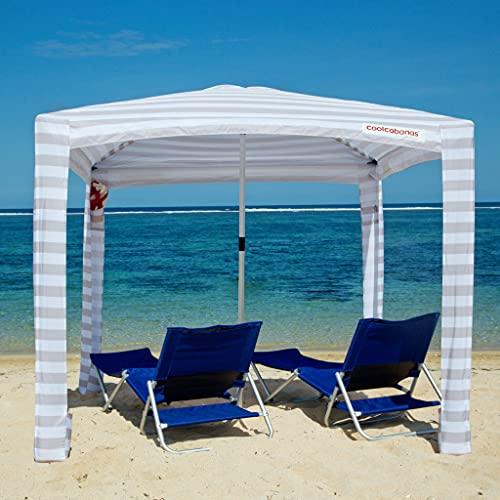 CoolCabana 5, Large An 8 x 8 ft shelter whose own sand pockets hold 35 lb of ballast, which is the whole argument for a cabana over an umbrella. | The most shade per pitch | CoolCabana does not publish a carry weight | $289.00 · View on Amazon |
| 4 | 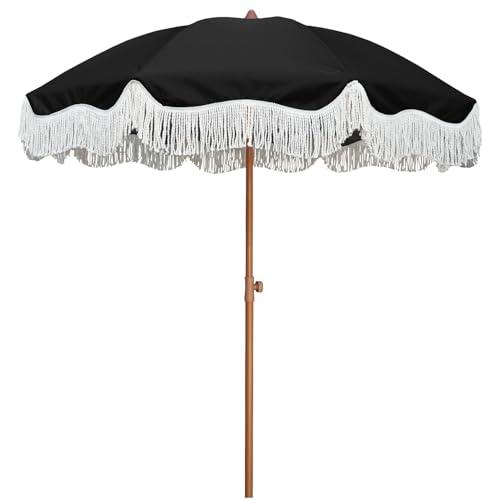 AMMSUN 6.5 ft Fringe Beach Umbrella A 7.15 lb tilting umbrella with eight ribs — the straightforward option when you are not buying a base. | The lightest full-size umbrella here | 7.15 lb (AMMSUN) | $65.85 · View on Amazon |
| 5 | 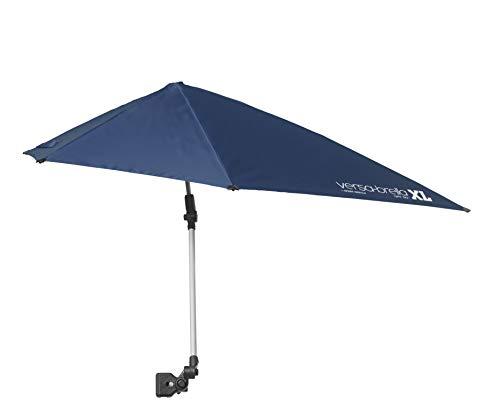 Sport-Brella Versa-Brella XL The larger clamp-on umbrella: 44 x 44 in of canopy at a listed 2.5 lb. | Clamp-on shade with more canopy | 2.5 lb per the distributor listing | $99.59 · View on Amazon |
Scroll the table sideways on a narrow screen. Every weight above is the figure its manufacturer publishes; where a manufacturer publishes none, the table says so rather than borrowing a retailer's number.
The short answer
What actually changes when the wind stops
Every other shade page on this site — and essentially every shade page anywhere — is written against wind, because wind is what breaks the product, empties the anchors and ends the afternoon. The advice that comes out of that is consistent and good: size down, over-anchor, pick stretch fabric, bury your pouches properly. On a genuinely calm day, most of that advice is either irrelevant or actively wrong.
The reason is the physics of wind load. Force on a canopy rises roughly with the square of wind speed and in direct proportion to the area exposed, which is why we tell people on exposed beaches to go one size down from their instinct: a 10 x 10 ft canopy pulls about four times as hard as a 5 x 5 ft one in the same gust. Take the wind speed to near zero and that penalty goes to near zero with it. Area stops costing you anything but carry weight and floor space.
Which means the calm-day question is not "what survives?" but "what keeps the most people comfortable for the least carrying?" Those are different questions with different answers, and this is the page for the second one. If you are here because you want shade that holds without burying sandbags, that is a separate problem with its own page: beach shade without sandbags. If your beach is actually windy, you want its mirror image: the best beach canopies for wind.
The criteria, and how each one inverts
We rank on the same four things on every shade page — weight, packed size, coverage and how it holds down. Here is what each is worth when the air is still, in the order that decides the purchase.
- Coverage per pound, with no size penalty. This is the criterion that moves to the top. On a windy beach, extra canopy is extra risk. On a calm one, extra canopy is just extra shade, and the only cost is what it weighs in your hand. So the right question becomes the one almost nobody asks: how many square feet am I getting per pound carried?
- Airflow, which replaces wind resistance as the thing to worry about. With no breeze, the air under a shade stops exchanging with the air outside it. An enclosed shade becomes a hot box, and shade that is hot is a poor return on a carry. Open sides and a high canopy stop mattering as wind-shedding features and start mattering as cooling ones.
- Anchoring, demoted to a safety margin. You still anchor, because a calm morning is a forecast and not a guarantee, and a sea breeze commonly builds through the afternoon. But you are anchoring against the chance of wind rather than the certainty of it, which means you can stop over-engineering and start saving yourself the digging.
- Setup effort, which becomes the real cost. When the hold-down requirement drops, the complicated pitch stops buying you anything. On a calm day a four-pole, four-pouch tent and a simple umbrella hold up equally well, so the umbrella's thirty-second setup is suddenly worth something the tent cannot match.
- Packed size and weight, unchanged. The one criterion the weather does not touch. You still have to carry it from the car.
Coverage per pound, which is the calm-day league table
| Shade | Canopy area | Carry weight | Square feet per pound |
|---|---|---|---|
| Sun Ninja 8-Person | 10 x 10 ft — 100 sq ft | 8.8 lb | About 11.4 |
| Sun Ninja 4-Person | 7.5 x 7 ft — 52.5 sq ft | 7.9 lb | About 6.6 |
| Sun Ninja 2-Person | 5 x 5 ft — 25 sq ft | 6 lb | About 4.2 |
| CoolCabana 5 Large | 8 x 8 ft — 64 sq ft | Not published | Cannot be calculated |
| AMMSUN 6.5 ft umbrella | 6.5 ft canopy | 7.15 lb | Cannot be compared directly |
| Neso Grande | Sized by Neso for 3-6 people | Not published | Cannot be calculated |
Published canopy area against published carry weight, using each maker's own figures. Only two makers in our registry publish both numbers for a group-sized shade.
Read down that first column and the calm-day argument makes itself. Within one product family, where the design and the fabric are constant, the 8-person is nearly three times as efficient per pound as the 2-person: 0.9 lb more than the 4-person buys you almost double the canopy. That is the sort of trade you are normally told to refuse, because on a windy beach you would be paying for it in anchor load. On a still day nobody is collecting.
Note also how many cells read "not published". Two of the best-known shade brands in this category will not tell you what their products weigh, which makes the efficiency question unanswerable for them. That absence is the reason this table is short, and it is a recurring theme on this site rather than an accident of this page.
The picks, and the honest objection to each
Sun Ninja Beach Tent, 8-Person — the calm-day buy
A 10 x 10 ft canopy, four poles, four sand pouches you fill on arrival, UPF 50+, and a published 8.8 lb in a 17.7 x 9.5 x 7.5 in bag. It shades eight people, or four people and all their gear, which on a hot windless beach is the difference between everyone sitting under it and half the group baking in rotation. Sun Ninja publishes weight, packed size and canopy area for every size it sells, which is why it is the only brand we can run a per-pound table on.
The honest objection: 100 square feet is a genuine sail, and we say elsewhere on this site that this is the size to skip on a gusty day. That warning still stands — it is simply the warning that does not apply here. The second objection does apply: a 10 x 10 ft footprint needs a patch of beach that a crowded shoreline on a perfect still day may not give you. And four buried pouches is a real pitch, not a pop-up. If you are pitching on dry sand, our beach tent setup guide covers getting the pouches properly buried rather than merely covered.
Sun Ninja Beach Tent, 4-Person — the one to buy if the beach is busy
The same design at 7.5 x 7 ft and a published 7.9 lb, which is the size most people should own and the one we recommend by default across the site. On a calm day it is the sensible pick for two to four people, for a beach where space is tight, or for anyone who does not want to commit to pitching a 10 x 10. It ships with a sand shovel and grass pegs, and it is machine washable, which matters more than it sounds after a season of salt.
The honest objection: on the per-pound table it is the worse buy — 0.9 lb lighter than the 8-person for roughly half the canopy. You are paying a real efficiency penalty for a smaller footprint, and the only good reasons to pay it are crowding and setup time. It is also still a four-pole, four-pouch pitch for a day that does not demand one. The full ranking is in the best beach tents, and the sizing argument is in beach tents for two people.
CoolCabana 5, Large — the most shade per pitch
An 8 x 8 ft shelter — 64 sq ft by CoolCabana's own figure, against roughly 28 sq ft for a typical 6 ft beach umbrella — held by sand pockets designed to take 35 lb of ballast, with a single middle pole on the large size where the medium uses two. One pole and one dig is the least fiddly way to get this much canopy up, which is exactly what a calm day rewards. UPF 50+.
The honest objection: CoolCabana does not publish a carry weight, which is a real gap on a product sold on portability and the reason it cannot appear in the table above. It folds to 3 ft 5 in, so it is a checked-bag item rather than a carry-on one, and on a windless day you are filling sand pockets designed for 35 lb of ballast you do not need — fill them part-way and save yourself the work. More in the best beach cabanas.
AMMSUN 6.5 ft Fringe Beach Umbrella — the calm-day umbrella
An umbrella is the format that benefits most from a still day, because its chief failure mode is wind and wind is what you do not have. The AMMSUN is 7.15 lb for a 6.5 ft canopy with eight reinforced ribs, a push-button tilt that matters more than buyers expect as the sun moves, and a published UPF 50+ blocking over 98% of UV. Thirty seconds to put up, no pouches to fill, no poles to thread.
The honest objection: no anchor or base in the box, and a plain umbrella is the single most common piece of airborne beach gear there is. The Consumer Product Safety Commission figure that beachBUB designs to — roughly 75 lb of resistance needed at the pole of a 7.5 ft umbrella — is not a number you reach by pushing a pole into sand by hand, and a calm morning turning breezy at two o'clock is the exact scenario that produces the injuries. Read the umbrella anchor page and how to anchor a beach umbrella before you buy one, and anchor it properly even today. Coverage is also the smallest of the group options here.
Sport-Brella Versa-Brella XL — shade for one, in a bag
A clamp-on umbrella: 44 x 44 in of canopy at a listed 2.5 lb, folding to roughly 40 x 4 in, with a universal clamp and a four-way swivel so it rotates to follow the sun. It is listed at UPF 50+ and as blocking 99.5% of UVA and UVB. Because it clamps to a chair, a stroller or a wagon frame, its ballast is whatever it is clamped to, which means no digging at all — the lightest possible answer to a calm hot afternoon for one person.
The honest objection: it shades one person and only while they stay in the chair. We found no manufacturer spec sheet for it, and sellers disagree on both the weight and the clamp width, so the figures here are a distributor's rather than a maker's. At 40 in folded it is longer than it sounds in a packed car. And a clamped umbrella in a sudden gust takes the chair with it, which is a different hazard rather than a smaller one.
Two things to deliberately not buy for a calm day
A wind-powered shade. The Shibumi Shade is the most interesting design in this category and it is the wrong product for this page. It works by letting the breeze inflate a loose canopy attached to a single arch, so with no air moving the fabric hangs instead of arching. Shibumi is straight about this: current shades ship with a sandbag Wind Assist precisely for days when there is barely a breeze, and that is a workaround rather than a cure — a canopy propped out with sandbags is doing a lesser job than one inflated by wind, and the sandbags are the sand weight the design was celebrated for avoiding. The published figures and the caveats are in our Shibumi Shade review, the mechanism is in how do Shibumi Shades work?, and the replacements are in Shibumi Shade alternatives.
A tent with sides. Sided and pop-up shelters earn their place on windy beaches and with small children, because they block blowing sand and give a baby somewhere out of the breeze. On a still day they are the worst thing you can pitch: with no cross-breeze there is nothing to exchange the air inside, and a closed nylon box in direct sun gets hot fast. If you need sides for a nap or a changing space, pitch it, use it and open it — but go in knowing what you are trading. We set out the full case both ways in beach tents with sides and shade for babies and toddlers.
The heat problem nobody warns you about
The reason a shaded beach feels pleasant is only partly the shade. A large part of it is moving air taking heat off your skin, and on a windless day that mechanism is simply absent. The practical consequence is that two shades blocking identical amounts of sun can feel completely different to sit under, and the one that feels better is almost always the one with more air moving through it.
- Open four sides wherever you can. An open canopy on four sides exchanges air with the beach even in near-still conditions, through convection if nothing else. Hot air rises out from under a high open canopy; it sits under a low closed one.
- Pitch high rather than low. A canopy pitched at full height has more volume of air under it to heat up and more room for that air to rise and leave. Pitching low is a wind tactic, and you are not fighting wind.
- Pitch near the water, not back in the dunes. Even on a still day, the sand-to-water temperature difference drives a weak onshore drift. Being closer to the water line is the cheapest airflow you can get.
- Put something reflective underneath. Dark towels on hot dry sand store and re-radiate heat. A woven mat sits cooler and lets sand fall through it, which is the argument in the best beach mats.
Anchoring on a calm day, done properly but not obsessively
You are anchoring against the chance of a breeze building, which on most coasts is a real chance rather than a theoretical one: the sea breeze is driven by land heating faster than water, so a still morning turning breezy by early afternoon is the normal pattern and not the exception. That sets a sensible middle course between over-digging and not bothering.
- Fill every anchor, but fill it part-way. Four pouches at half capacity still beats three pouches at full, because what fails first is the empty corner. Even weight across the corners matters more than total weight when there is nothing pulling hard.
- Bury rather than pile. Sand piled on top of a pouch blows and trickles away; sand with the pouch dug into it does not. This is the same technique as on a windy day and it takes no longer.
- Anchor the umbrella properly regardless. This is the exception to relaxing. An umbrella that lifts becomes a rigid pole traveling at speed, and the forecast is not a guarantee.
- Look up at two o'clock. If the flags have started moving and you are under a 10 x 10 canopy, that is the moment to top up the pouches rather than the moment to watch it go. The full set of techniques is in keeping a beach tent from blowing away.
Which one to carry
Size up if
- You are shading a group, or a small group plus all the gear
- The forecast is genuinely still, not just 'light winds'
- The beach is wide enough for a 10 x 10 ft footprint
- You are driving to the beach rather than flying
- You would rather carry 0.9 lb more than rotate people in and out of the shade
Stay small if
- The beach is crowded and floor space is the real constraint
- You are one or two people and setup time matters more than coverage
- You are flying — the 2-person Sun Ninja is 15.7 in packed and fits inside a carry-on
- The forecast says calm but the coast you are on says otherwise
- You want to put it up and sit down inside a minute, which is an umbrella's argument
Where this sits against the rest of the site
This page is the deliberate opposite of our wind coverage, and both are honest. If you do not know which conditions you are buying for — most people are buying one shade for a whole coastline — buy for wind, because a shade that holds in a breeze also works in still air while the reverse is not true. Start with the best beach tents for the default recommendation, shade for wind if your coast is exposed, and are beach tents worth it? if you are not sure you want to carry one at all. If you are hauling a big canopy and a cooler across soft sand, the thing that makes that trip bearable is in our Mac Sports Beach Day Lounger review.
Every pick in full
#1 · Big groups
Sun Ninja Beach Tent, 8-Person
The 10 x 10 ft version of the same design: four times the footprint of the 2-person for less than 3 lb more carry weight.
| Carry weight | 8.8 lb in its bag (Sun Ninja) |
|---|---|
| Packed size | 17.7 x 9.5 x 7.5 in carry bag (Sun Ninja) |
| Size / capacity | 10 x 10 ft canopy, four poles |
| Setup | Four buried sand pouches; longer to pitch than the smaller sizes |
| How it holds down | Sand-pouch anchoring; a bigger canopy catches proportionally more wind |
| UPF / materials | UPF 50+ (Sun Ninja) |
What it does well
- Covers eight people for under 9 lb — the best shade-per-pound figure here
- Only 0.9 lb heavier than the 4-person for nearly double the canopy
- Same sand-pouch anchoring as the smaller sizes, scaled up
Where it falls short
- A 10 x 10 ft canopy is a genuine sail; this is the size to skip on a gusty day
- Needs a bigger patch of beach than crowded shorelines always have
Specifications above are Sun Ninja's own, read from their published listing.
#2 · Most beach days
Sun Ninja Beach Tent, 4-Person
A pole-and-sand-anchor shade that covers a family without the bulk of a cabana, and the size most people should start with.
| Carry weight | 7.9 lb in its bag (Sun Ninja) |
|---|---|
| Packed size | 17.7 x 7.5 x 7.1 in carry bag (Sun Ninja) |
| Size / capacity | 7.5 x 7 ft canopy, four poles |
| Setup | Bury four sand pouches, raise the poles; pegs included for grass |
| How it holds down | Held by sand-filled pouches you dig in, not pegs pushed into dry sand |
| UPF / materials | UPF 50+ (Sun Ninja) |
What it does well
- The best size-to-weight balance in the range: family coverage under 8 lb
- Sand-pouch anchoring works in dry sand, where tent pegs simply pull out
- Machine washable, which matters more than it sounds after a season of salt
- Ships with a sand shovel and grass pegs, so it works away from the beach
Where it falls short
- Four poles and four buried pouches is a real setup, not a pop-up
- An open canopy: it blocks sun from above but gives no shelter from blowing sand
Specifications above are Sun Ninja's own, read from their published listing.
#3 · The most shade per pitch
CoolCabana 5, Large
An 8 x 8 ft shelter whose own sand pockets hold 35 lb of ballast, which is the whole argument for a cabana over an umbrella.
| Carry weight | CoolCabana does not publish a carry weight |
|---|---|
| Packed size | Folds to 3 ft 5 in (CoolCabana) |
| Size / capacity | 64 sq ft of shade, 8 x 8 ft |
| Setup | One middle pole on the large size, plus a sand spike |
| How it holds down | Sand pockets hold 35 lb of ballast (CoolCabana) |
| UPF / materials | UPF 50+ (CoolCabana) |
What it does well
- 64 sq ft against roughly 28 sq ft for a typical 6 ft beach umbrella, by CoolCabana's own comparison
- Ballast is designed in: the sand pockets take 35 lb with no extra anchor to buy
- One middle pole on the large size, where the medium uses two
Where it falls short
- Folds to 3 ft 5 in, so it is a checked-bag item, not a carry-on one
- No published carry weight, which is a real gap on a product sold on portability
#ad Price as of November 28, 2026. How this is funded
Specifications above are CoolCabana's own, read from their published listing.
#4 · The lightest full-size umbrella here
AMMSUN 6.5 ft Fringe Beach Umbrella
A 7.15 lb tilting umbrella with eight ribs — the straightforward option when you are not buying a base.
| Carry weight | 7.15 lb (AMMSUN) |
|---|---|
| Packed size | Not published; a folded 6.5 ft umbrella is roughly 5 ft long |
| Size / capacity | 6.5 ft canopy |
| Setup | Push-button tilt; the pole is screwed or augered into sand |
| How it holds down | Eight reinforced ribs and a lock slider; no ballast base is included |
| UPF / materials | UPF 50+, blocks over 98% of UV (AMMSUN) |
What it does well
- 7.15 lb is genuinely light for a 6.5 ft canopy
- Push-button tilt, which matters more than buyers expect as the sun moves
- AMMSUN publishes both the UPF rating and the UV block percentage
Where it falls short
- No anchor or base in the box — budget for one, and read our anchor guide first
- A plain umbrella in wind is the single most common piece of airborne beach gear
#ad Price as of November 28, 2026. How this is funded
Specifications above are AMMSUN's own, read from their published listing.
#5 · Clamp-on shade with more canopy
Sport-Brella Versa-Brella XL
The larger clamp-on umbrella: 44 x 44 in of canopy at a listed 2.5 lb.
| Carry weight | 2.5 lb per the distributor listing |
|---|---|
| Packed size | Folds to roughly 40 x 4 in per the distributor listing |
| Size / capacity | 44 x 44 in open |
| Setup | Universal clamp onto a chair, stroller or rail; four-way swivel |
| How it holds down | Clamped, so its stability is whatever it is clamped to |
| UPF / materials | UPF 50+, listed as blocking 99.5% of UVA and UVB |
What it does well
- A good deal more canopy than a standard clamp umbrella for half a pound more
- Clamps to things that are not chairs — strollers, rails, wagon frames
Where it falls short
- We found no manufacturer spec sheet; sellers disagree on the weight and the clamp width
- At 40 in folded it is longer than it sounds in a packed car
#ad Price as of November 28, 2026. How this is funded
Specifications above are Implus distributor listing's own, read from their published listing.
Questions people actually ask
+What is the best beach shade for a calm day?
+Do I still need to anchor beach shade if there is no wind?
+Does a Shibumi Shade work on a calm day?
+Why does shade feel hotter on a windless day?
+Should I buy a beach tent with sides for a calm day?
+Is an umbrella enough on a calm day?
Sources
- Sun Ninja — 8-person tent listing, confirmed on sale with the 17.7 x 9.5 x 7.5 in / 8.8 lb carry bag figures (read 4 November 2026)
- Sun Ninja — 4-person tent listing, for the 7.9 lb weight, 7.5 x 7 ft canopy and UPF 50+ rating
- CoolCabana — CoolCabana 5 listing, for the 64 sq ft area, 35 lb sand-pocket ballast and 3 ft 5 in fold
- beachBUB USA — All-In-One system, the source of the CPSC 75 lb resistance figure for a 7.5 ft umbrella
- Implus distributor listing — Sport-Brella Versa-Brella XL, for the 2.5 lb weight and 44 x 44 in canopy